World Day Against the Death Penalty: 8,260 Executions in Iran and 926 in Kurdistan Over 14 Years
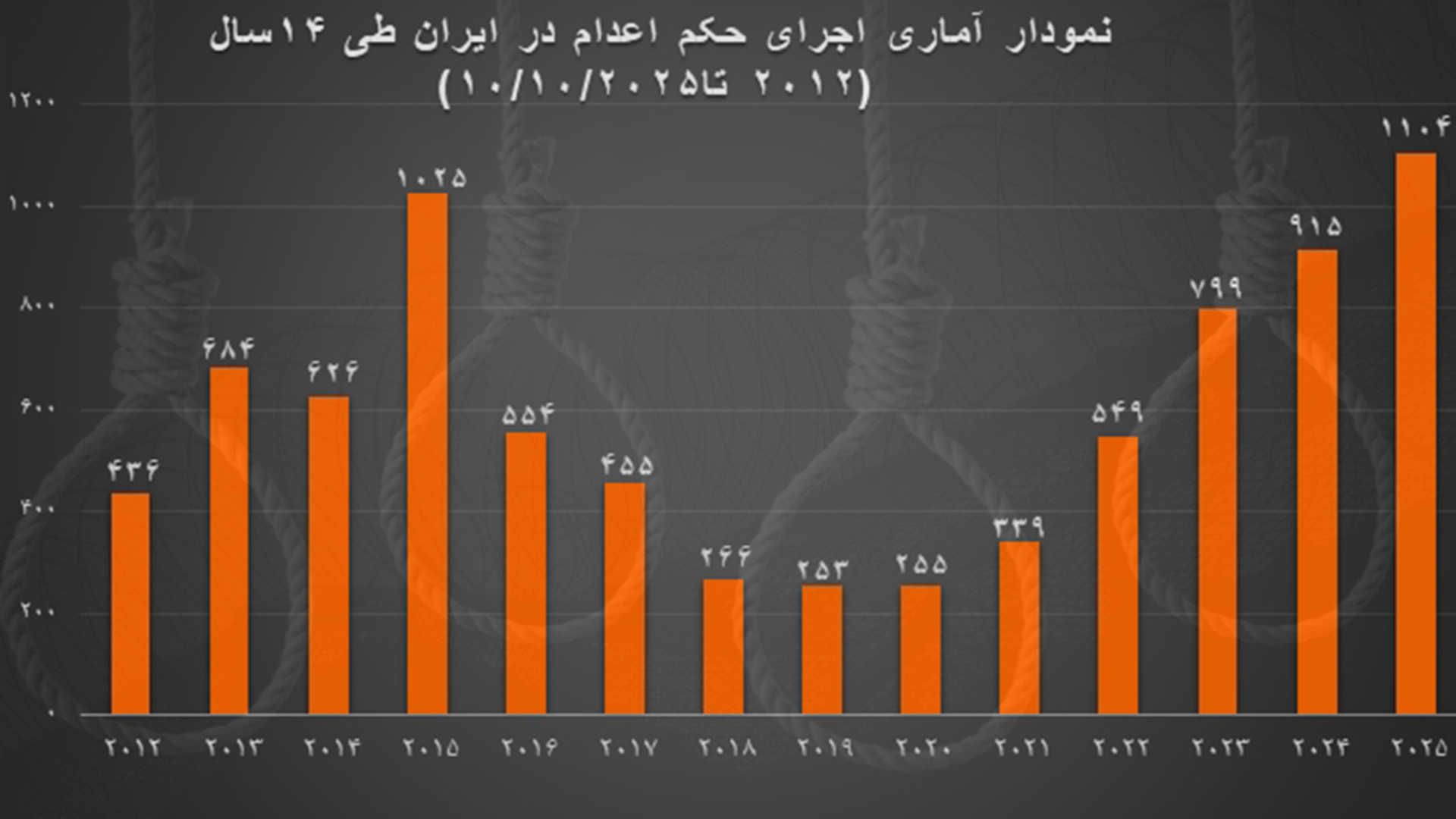
On the occasion of October 10, the World Day Against the Death Penalty, the Statistics Center of the Kurdpa Human Rights Organization publishes a statistical and categorized report on the status of executions in Iran and Kurdistan. This report includes execution statistics for the first nine months of 2025, as well as the recent fourteen-year period (from 2012 to October 10, 2025).
According to data recorded at the Kurdpa Statistics Center, during this period, 8,260 individuals were executed in Iran, of whom 926 were in Kurdistan.
Overview of Execution Statistics from the Beginning of the Year to October 10, 2025
Executions by the Islamic Republic in this period reached 1,104 cases, higher than any of the past 14 years.
The Islamic Republic carried out executions in 75 different prisons across Iran.
More than 94% of the executions were never announced by state media, and 63 cases were carried out as group executions.
The highest number of executions of political prisoners, totaling 24 cases, was related to espionage charges in this same year.
Public executions increased by 6 cases, and the execution of child offenders continues.
Kurds and Balochs continue to have the highest statistics of executions.
Statistical Details of 2025 Executions:
Charges:
Political Prisoners: 24 cases (Hamid Hossein-Nezad Haydaranlo (Kurd), on the charge of "Baghi" ); (Mohsen Langer-Neshin, Pedram Madani, Esmail Fekri, Majid Mosayebi, Mohammad-Amin Mahdavi Shayesteh, Edris Ali (Kurd), Azad Shojaei (Kurd), Rasool Ahmad Rasool (Kurd), Rouzbeh Vadi, Babak Shahbazi, Bahman Choobi-Asl on charges of "Moharebeh" and "Efsad-fel-Arz" through espionage for Israel); (Mojahed Kourkour (Bakhtiari) and Mehran Bahramian, detained during the "Jin, Jiyan, Azadi" uprising on charges of "Moharebeh"); (Mehdi Hasani and Behrouz Ehsani Eslam-lo on the charge of membership in the Mojahedin-e Khalq); (6 Arab political prisoners: Ali Mojadam, Moein Khanfari, Salem Mousavi, Mohammad Reza Moghaddam, Adnan Alboshokeh (Ghabishavi), Habib Deris, on the charge of "Baghi"); (Rostam Zeineddini (Baloch), membership in Jaish al-Adl).
Prisoners of Conscience: 1 case (Saman Mohammadi Khiyareh (Kurd)).
Drug-related offenses: 547 cases.
Murder: 482 cases.
Premeditated murder and drug offenses: 2 cases.
Moharebeh through armed robbery: 7 cases.
Armed robbery and murder: 1 case.
Rape, sexual assault, rape and murder: 23 cases.
Forced sodomy: 1 case.
Membership in extremist religious groups: 14 cases (Salafi: 7 individuals, membership in ISIS: 10 cases).
Furthermore:
Executions of Ethnic Groups: 113 Baloch, 110 Kurds, 57 Afghans, 22 Arabs, 6 Bakhtiaris, 5 Lurs (and likely 48 other Lurs), 4 Turks, 2 Turkmens, 1 Gilak.
Execution of Child Offenders: 4 cases (Karim Farkhvand and Mahmoud Ostad-Momzaei on charges of armed robbery, Behnam Bargpoush in connection with drug offenses, Mohammad Reza Shihaki on murder charges).
Public Executions: 6 cases in the cities of Nourabad (Luristan), Miandoab and Bukan (West Azerbaijan), Semnan, Laristan (Fars), and Kordkuy (Golestan).
Executed Women: 30 cases.
General Overview of Execution Statistics Over the Last 14 Years
During these 14 years, 8,260 individuals were executed in Iran by the Islamic Republic.
926 execution cases involved Kurdish citizens. Note: this only includes cases verified by Kurdpa, as the number of executions in prisons located in Kurdish cities is higher.
Drug-related offenses (over 49%), murder (over 35%), and rape charges (over 4%) were the top three charges leading to execution during these 14 years.
Execution trends for drug-related offenses saw a decline until 2021 and then experienced an upward trend again.
During these 14 years, specifically 102 political prisoners, 27 prisoners of conscience, and 68 "security" prisoners were executed in connection with "violent acts."
290 individuals were executed in public over these 14 years.
Except for 2012 and 2016, a total of 50 child offenders were executed in Iran.
225 women were executed during this 14-year period.
Generally, 94% of executions are not publicized by the government, and more than 60% are carried out as group executions in prisons.
102 Political Executions Over 14 Years
Over the past 14 years, 102 political prisoners were executed, including 37 Kurdish political prisoners, 20 Baloch political prisoners, 12 Arab political prisoners, one Turk political prisoner, and 32 other political prisoners. Among these executions, 24 sentences were carried out on charges of espionage.
Execution of Political Prisoners on Espionage Charges Over 14 Years (by year):
2013: Two unnamed individuals for espionage for the Mossad and the CIA.
2019: Jalal Haji Zavar, a contract employee of the Ministry of Defense Aerospace Organization, for espionage for the CIA and the U.S. government.
2020: Reza Askari, a retired employee of the Ministry of Defense, for espionage for the CIA, and Seyyed Mahmoud Mousavi-Majd (military), for espionage for the CIA.
2023: Execution of four prisoners accused of "participation in intelligence cooperation and espionage for the benefit of Israel," including Wafa Hanareh, Aram Omari, Rahman Parhazo, and Nasim Namazi in Urmia Central Prison.
2024: Mohsen Mazloum, Pejman Fatehi, Wafa Azarbar, and Mohammad Faramarzi, four Kurdish political prisoners, for espionage for Israel.
2025: Mohsen Langer-Neshin, Pedram Madani, Esmail Fekri, Majid Mosayebi, Mohammad-Amin Mahdavi Shayesteh, Edris Ali (Kurd), Azad Shojaei (Kurd), Rasool Ahmad Rasool (Kurd), Rouzbeh Vadi, Babak Shahbazi, and Bahman Choobi-Asl for "Moharebeh" and "Efsad-fel-Arz" through espionage for Israel.
29 Executions of Prisoners of Conscience Over the Last 14 Years
During the past fourteen years, 29 prisoners of conscience were executed, 24 of whom were Kurds. These individuals were targeted due to their religious affiliations. The Islamic Republic has demonstrated that even without committing violent acts, it punishes them through security case-building and the death penalty, a clear violation of human rights and religious freedoms.
Additionally: During the past fourteen years, 85 prisoners were executed on "security" charges related to what the government calls "violent acts"; including 22 individuals accused of attacking the armed forces parade in Ahvaz, 19 accused of membership in Jaish al-Adl, 15 accused of the Tasu'a 2018 bombing in Chabahar (Baloch), 8 accused of membership in ISIS and attacking the Parliament building (Kurd), 4 accused of bombings in Ahvaz, 7 accused of membership in extremist Salafi groups, and 10 accused of membership in ISIS.
In general, Kurdpa has categorized political, conscience-based, and "security" prisoners solely for transparency, as the Islamic Republic defines all these individuals within a security framework and carries out the death penalty regardless of the actual nature of their charges, which is a clear violation of human rights.
290 Public Executions Over 14 Years
During these fourteen years, 290 individuals were executed in public. After a decrease in public executions, the Islamic Republic temporarily halted them in 2021 but resumed them in 2022. Subsequently, 2, 4, and in 2025, 6 individuals were executed in public, an act that is a clear violation of human rights and human dignity.
These statistics are compiled solely based on recorded information from reliable sources, but it is likely that the actual number of executions is much higher. This is because more than 94% of executions are not officially announced, and on the other hand, the suppression of freedom of expression, restrictions on independent journalists, and the obstruction of human rights organizations make it difficult to access accurate information regarding human rights violations.
Compiled by: Awin Mostafazadeh