March 8, 2026 Kurdish Women from the "Jin, Jiyan, Azadi" Paradigm to Reclaiming Fundamental Rights at the Intersection of Intersectional Oppressions
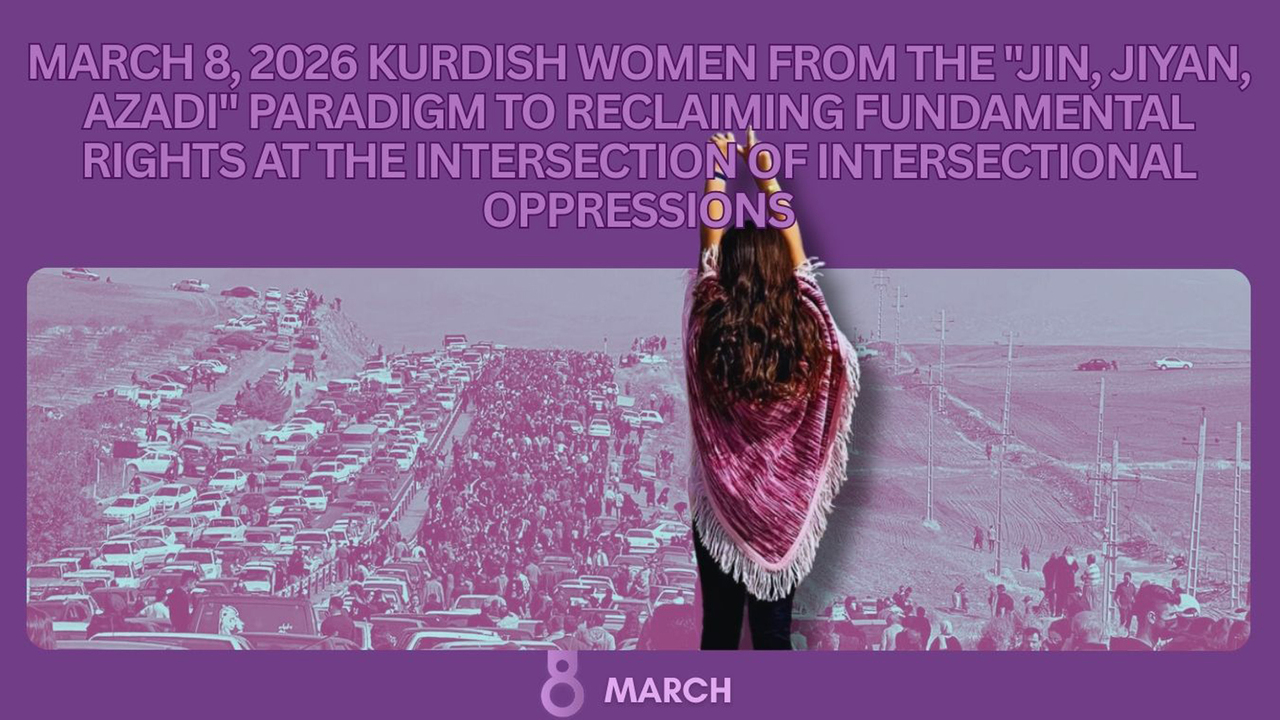
Kurdish women in the Kurdistan of Iran are welcoming International Women's Day while Iran is engaged in a military conflict, and the government has placed Iran and Kurdistan in a news deadlock through intentional deprivation and a nationwide internet shutdown. March 8 this year has arrived in a year where the Islamic Republic, with this systematic blockage, does not allow the resonant voice and rightful demands of women in these critical conditions to reach the world. However, this statement is a response to that imposed silence; it is a cry rising from decades of struggle and exorbitant costs, drafted based on fundamental human rights principles to emphasize the historical demands of these women beyond the walls of censorship.
After years of continuous struggle, Kurdish women have transformed the revolutionary and progressive "Jin, Jiyan, Azadi" uprising into their identity and legal discourse. This movement was not merely a street protest; it was the reclaiming of "human agency" against decades of structural oppression. Today, Kurdish women, relying on this discourse, speak out not only against gender apartheid but also to express their "fundamental issue" which is rooted in historical discrimination. Kurdish women today, relying on this discourse, speak out not only against gender apartheid but also to express their "fundamental issue" which is rooted in historical discrimination. She uses this power and discursive space, which is the product of her own direct struggle, cost, and demand-making and has extended it to the world, to show how her identity has become a target of systematic elimination amidst the gears of centralism, extreme religious-centrism, and institutionalized patriarchy.
From a human rights perspective, this conscious uprising is the manifestation of Article 1 of the International Covenant on Civil and Political Rights (ICCPR), namely the right to self-determination in all individual and collective dimensions. This statement is a document of the truth that no intentional silencing can consign to oblivion a discourse that has taken root in the heart of society and for which lives have been sacrificed.
1. Explaining the Concept of Intersectional Oppression for the Kurdish Woman Issue
On the eve of March 8, 2026, while military combat and the complete blockage of information have placed Iran in an emergency state, analyzing the situation of Kurdish women becomes doubly necessary. The issue of the Kurdish woman is not a "feminine guild issue," but a prime example of "intersection of oppression" in the political geography of Iran. She is simultaneously the target of four layers of suppression:
- Gender: Discriminatory laws that consider women across Iran as second-class citizens.
- Identity: Deprivation and suppression due to being "Kurd," aimed at the assimilation of Kurdish identity.
- Religion: Double pressure on women in a region where the majority are outside the circle of the official religion of the government.
- Economic Oppression: A security-oriented view toward the Kurdistan province, which has led to intentional economic backwardness in Kurdistan and is itself the source of many harms.
These layers, instead of merely existing side-by-side, intensify one another and have created an "emergency existence" for the Kurdish woman. This reality has placed the Kurdish woman in a situation where the struggle for her gender rights alone cannot respond to the intersectional oppression against her; because her other identities cannot be stripped away to define her merely in one identity (based on which she is under oppression).
From a human rights perspective, this situation is a clear example of the violation of Article 2 of the "International Covenant on Civil and Political Rights" (ICCPR), which prohibits any discrimination based on race, color, sex, language, and religion.
2. Organizational Existence: Resistance against Civil Blockage from Official Activity to Resistance Circles
One of the most prominent achievements of Kurdish women is their "organizational existence." For decades, despite systematic suppressions, they have established the most progressive civil institutions in the fields of women's rights, the environment, and culture. The fundamental difference of the women's movement in Kurdistan is its "organized nature" and "deep-rootedness" in various social layers.
In past decades, the Islamic Republic, with a security approach, has blocked all official avenues of activity (NGOs), revoked licenses, and sealed offices. However, the analysis of the behavioral pattern of Kurdish women shows that by transitioning from "official structures" to "informal and circle networks," they have prevented the collapse of collective awareness. These organizations, which have been active in the fields of women's rights, the environment, civil society, literature, and mother tongue and every issue of society, appeared on the scene with more power and cohesion at times when the government thought it had uprooted them, the peak of which we saw in the "Jin, Jiyan, Azadi" uprising.
This continuity is a sign of political maturity that has preserved the right to assembly and association (Article 20 of the Universal Declaration of Human Rights) not as a granted privilege, but as an impregnable bastion.
3. Progressive Struggle against Systematic Violence and "Femicide"
Kurdish women in Kurdistan have been pioneers in the struggle against the hardest layers of violence. They have fought on two fronts simultaneously:
- Legal Front: Against laws that authorize violence.
- Social Front: Against reactionary traditions and "honor killings."
Analysis of statistics and suppression patterns shows that the sovereignty has regarded women's awareness-raising regarding "Femicide" as a security threat. The arrest of activists striving to save the lives of women at risk, as well as the revocation of licenses for women's organizations and the prevention of any ceremonies specific to March 8 or November 25 and field work by women to combat violence (which was in conflict with the security view and the immunity of violence against women from the government's perspective), indicates that the liberation of the Kurdish woman from the bonds of imposed traditions is in conflict with the political security of the system.
But the great achievement of this struggle was the change of discourse in the heart of Kurdistan's society, which, in the "Jina" revolution, also brought men into the ranks of egalitarian demand-making.
The suppression of activists countering femicide and the prevention of March 8 gatherings is a clear violation of Articles 2 and 5 of the CEDAW Convention (the obligation of states to nullify discriminatory traditions) and Article 6 of the ICCPR Covenant (the duty of the government to safeguard the right to life). By criminalizing the activities of women's rights defenders, the sovereignty has violated its international obligations regarding "Due Diligence" to prevent gender-based violence and has practically legitimized the reproduction of violence.
4. Kurdish Female Political Prisoners: The Forefront of Suppression and Symbol of Demand-Making Diversity
In recent years, the detention of Kurdish women has become one of the main tools of layered suppression. Today, we are faced with dozens of Kurdish female political prisoners detained for diverse reasons. These arrests have a targeted pattern:
- Diversity in Prisoner Identity: From Kurdish language teachers who strived for the right to mother-tongue education (Article 27 of the International Covenant) to environmental activists who consider the earth part of human identity, and civil activists and women's rights activists who have been in motion against social suppression and judicial suppression.
- Torture and Forced Confessions: The use of long-term detentions in solitary confinement, deprivation of access to a lawyer, and double pressure on families are all tools to break the will of women who have become symbols of "resistance." This procedure is a clear violation of the "Convention against Torture," which has unfortunately intensified in the shadow of the news silence resulting from the internet shutdown.
Nonetheless, it is necessary to mention that this layer of suppression has not been able to push back the demands and struggle of Kurdish women; rather, for many of them, prison has turned into a bastion of resistance and continuity of struggle. The agency and combative steadfastness of these women have pushed back suppression, and prison has not only failed to silence their voices but has made their demand-making stronger from within the wards, turning the prison into a trench for continuing the path.
These widespread and arbitrary detentions are a clear violation of Article 9 of the ICCPR Covenant (the right to liberty and security of person) and Article 14 (the right to a fair trial). Also, exerting pressure on families and long-term solitary confinements are clear examples of torture and inhuman treatments according to the Universal Declaration of Human Rights, carried out with the aim of eliminating the "political agency" of women.
5. The "Jin, Jiyan, Azadi" Revolutionary Uprising: Arising from the Heart of Seeking Justice and Women's Agency
The pioneering presence of Kurdish women in the current revolution is not a sudden occurrence, but the fruit of a deep-rooted tree that has been watered with blood and standing for decades. The "Jin, Jiyan, Azadi" revolutionary uprising was the manifestation of decades of under-the-skin struggle by Kurdish women. The bold presence of women at the funeral ceremony of "Jina Amini" and the reading of strong legal and political statements showed that the Kurdish woman is at the head of fundamental changes in Kurdistan and Iran.
This revolutionary uprising showed that Kurdish women are not only seeking their guild rights, but have opened a new horizon of freedom for all of Kurdistan and Iran. Their unique role in symbolic ceremonies and progressive statements has opened a new front of "political justice-seeking." The funeral ceremony of "Jina Amini" and the statements arising from it were a turning point in contemporary political history; Kurdish women in that field transformed "mourning" into "political agency."
This movement was completed by the unique role of seeking-justice mothers; women who for decades have kept the files of the disappeared and the executed open. They struggle not only for their children but for the "Right to the Truth" and have linked the chain of justice-seeking from the black decades of the past to today's generation. Kurdish justice-seeking mothers have today turned into a civil institution that, despite arrest and threats, has extended this chain to the "Jina" generation.
This persistence in seeking justice is the manifestation of the "Right to the Truth," which is recognized in international human rights documents as a tool to end impunity. Also, transforming mourning into protest embodies Article 19 of the ICCPR Covenant (freedom of expression and opinion) in its most radical civil form, which the sovereignty has violated by suppressing it, denying the fundamental collective right to seek justice.
6. March 8, 2026; Human Rights in the Deadlock of War and Censorship
Today we have reached March 8 while the Islamic Republic, under the cover of war conditions, has once again turned to the overt suppression of citizens' basic rights and has placed Iran and Kurdistan in complete communication and news blackout. The nationwide internet shutdown and the blockage of information tools are a deliberate strategy to hide the widespread violation of civilian rights and exert double pressure on women activists in a space away from international monitoring.
We strongly condemn that the sovereignty uses the critical state of war as a tool to stifle the voice of protests and suppress demands even more severely. The communication blackout in Iran and Kurdistan should not and cannot become a cover for war crimes, arbitrary detentions, and violence against women. According to international law, access to information during war is not a privilege, but a "tool for survival" for civilians, and intentionally depriving people of it is a clear violation of the Additional Protocols to the Geneva Convention and a crime against the right to human security.
The intentional deprivation of society from communication tools in the midst of armed conflicts by the Islamic Republic is a clear violation of Article 19 of the ICCPR Covenant (the right to seek and disseminate information) and the trampling of fundamental principles of International Humanitarian Law (IHL). This action by the sovereignty, carried out with the aim of creating fear and terror and preventing the documentation of human rights violations, is condemned by international organizations, and the legal responsibility for any human catastrophe in this news vacuum lies directly with the sovereign institutions.
7. Kurdish Women's Demands; Fundamental Human Rights Demands
We believe that the issue of the Kurdish woman is the "gauge of democracy" in Iran. No change will be sustainable unless the intersectional discriminations against these women are recognized and rectified; because any effort to ignore this intersectional oppression is nothing but the continuation of injustice. As a human rights institution, we demand based on international conventions:
- The unconditional release of all Kurdish female political prisoners: ending criminalization and security case-building against civil and identity-seeking activism.
- Recognition of the intersectional rights of Kurdish women: nullifying all gender, identity, and religious discriminatory laws.
- Ending the garrisoned and militarized state in Iran and Kurdistan: stopping policies that directly target the security, livelihood, and dignity of women and returning the internet as a vital infrastructure, especially under the shadow of a government that has blocked all paths and does not accept its responsibility to defend the people.
- Guaranteeing the freedom of activity for independent women's organizations: ending the judicial prosecution of their members and respecting the right to organize.
"Jin, Jiyan, Azadi," which has become global today, is not an abstract slogan, but the product of the suffering and struggle of thousands of Kurdish women who have depicted the brightest human horizon against the darkest forms of tyranny. March 8, 2026, is the day of re-confirming this bloody covenant between freedom and equality; just as on the date of January 6, 2026, six women's organizations from within the country correctly pointed to it in a statement.